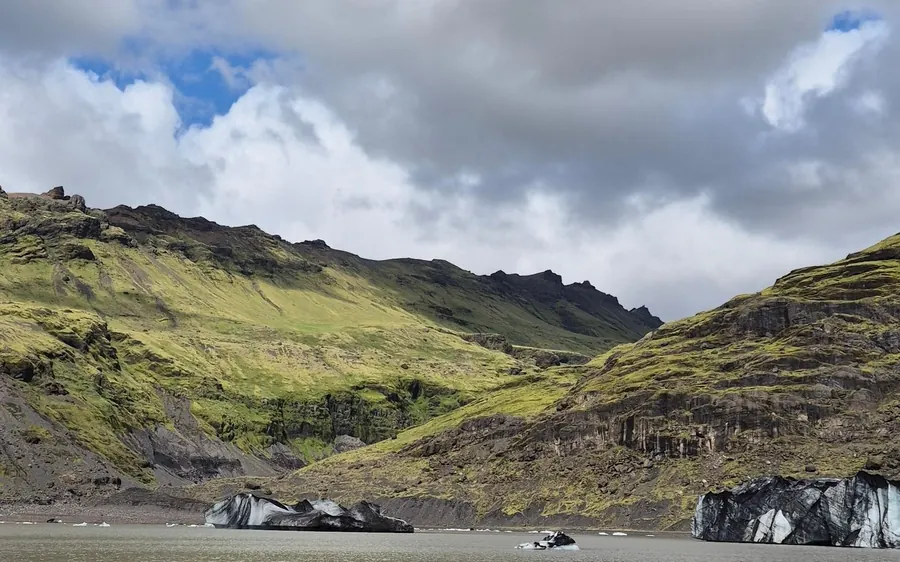
Lowest price hereRated 4.8
5.5 hGuided Glacier Hike
★ 4.8 · 146 reviews
- 5.5 hours, Family walk, classic hike or longer
- Base camp by the car park
- Cheapest here
- Free cancellation
$101$18.36 / hour
Check availability→ Gear and clothing
The technical equipment is not your problem. Every one of the sixteen guided walks on this site supplies glacier crampons, a helmet and a harness, and several add an ice axe — you are fitted with all of it at the meeting point and shown how to use it. What you bring is clothing: warm layers, a windproof jacket and sturdy boots that a crampon can be strapped to. Here is the full list, what each operator supplies, and what happens if you turn up short, from $101.
Quick answer
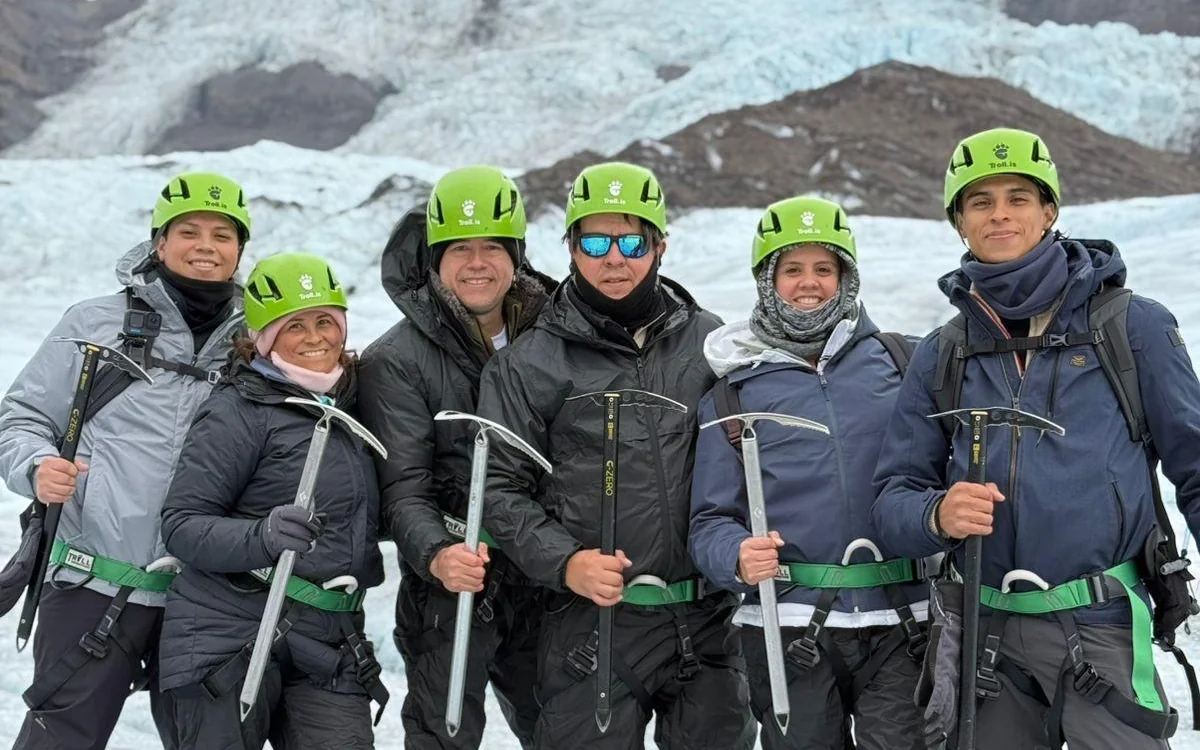
The short answer. Bring warm layers, a windproof and water-resistant jacket, sturdy closed boots that cover the ankle, a hat, gloves, sunglasses and sunscreen. The operator brings the crampons, the helmet, the harness and, on most walks, an ice axe. Nobody expects you to own mountaineering equipment — every listing here includes it in the price.
Why the gear question is simpler here than you think
The technical kit is included. The clothing is yours.
There is one fact that settles most of this page: you do not walk onto an Icelandic outlet glacier on your own, and you do not walk on one in ordinary shoes. The ice is reached with a certified guide and crossed in crampons, and that is how all sixteen listings on this site are sold. Every one of them is guided, and every one of them includes the technical equipment in the price.
That removes the question people worry about most. You do not need to own crampons, hire them, or know how to fit them. At the meeting point you are given a pair, they are adjusted to your boots, you get a helmet and a harness, and the guide shows you the walking technique — short steps, flat foot, the whole set of points biting at once. It takes a few minutes and it becomes automatic quickly. The listings carry 11,888 reviews between them, and the overwhelming majority of those reviewers had never worn crampons before.
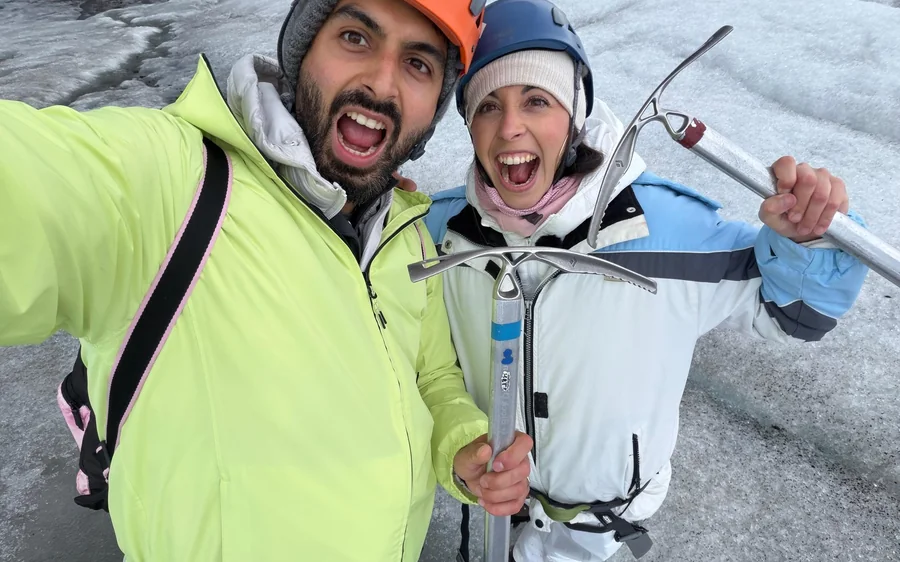
Some walks go further. $209 includes ice axes and ropes for an optional introduction to ice climbing, which is why its equipment list is the longest here. $285 adds headlamps, because the six-hour trip ends inside a cave. $106 includes the Vatnajökull National Park fee as well as the gear and the 4x4 to the glacier edge.
What no listing supplies is your clothing. That is the part worth packing carefully, and the rest of this page is about it.
Who brings what
Read this before you pack. Everything in the left column that says "The operator" is already in the price of your walk.
| Item | Who provides it | Where it appears |
|---|---|---|
| Glacier crampons | The operator | On every one of the sixteen listings |
| Helmet | The operator | Listed on the walks that publish full gear |
| Harness | The operator | Listed on the walks that publish full gear |
| Ice axe | The operator | On the hikes that include one, e.g. $106 |
| Ropes | The operator | On the ice climbing intro at $209 |
| Headlamp | The operator | On the remote cave trip at $285 |
| A certified glacier guide | The operator | Every walk here is guided |
| Warm layers, jacket, boots | You | Nothing on the listings supplies your clothing |
| Hat, gloves, sunglasses | You | Small items, and the ones most often forgotten |
| Water and a snack | You | Some walks include coffee; none replace lunch |
The clothing list, in the order it matters
Boots first, then layers, then the small things people forget.
Start with the feet, because they decide whether crampons work. You want a sturdy closed boot that covers the ankle and has a firm sole — something a strap-on crampon can grip without flexing. Trainers, canvas shoes and soft-soled walking shoes are the ones that cause problems at the meeting point. Several operators rent boots if yours are not suitable, and that is a question to ask when you book rather than on the morning.
Then layers. A base layer that is not cotton, a warm mid layer such as fleece or a light insulated jacket, and a windproof, water-resistant shell over the top. Wind is what makes an Icelandic glacier feel cold rather than air temperature alone, and a shell is what stops it. The layered approach also lets you shed on the walk in and add at the stops, which is exactly how a guided hour on the ice goes.
Then the small things, which are the ones people leave in the car. A hat and gloves — thin liner gloves are easier for a camera than thick ones. Sunglasses, because ice reflects light upwards as well as down, which catches out people who rarely burn. Sunscreen for the same reason, in every season.
Finally, water and something to eat. Several walks include coffee and chocolates — $120 and $106 both do, and $101 lists tea, coffee and water — but none of them is a meal, and the long days from Reykjavík run eleven and thirteen hours.
The packing list
This works for every walk on the site, from the 2.5-hour encounter at Skaftafell to the thirteen-hour day from Reykjavík.
The one item worth getting right. A firm sole lets the crampon grip properly. Ask about boot rental when you book if you are travelling light — it is a standard question and the operators are used to it.
Fleece or a light insulated jacket. The valley can be mild and the ice cold on the same morning, and the item people most often wish they had packed is one more warm layer.
Wind is what makes a glacier feel cold, and weather on the South Coast moves quickly. A shell over your warm layer handles both wind and passing rain.
Denim holds water and stays cold once it is wet. Any quick-drying walking trouser is a better choice, with a thermal layer under it in the colder months.
Small, light, and the difference between enjoying the walk and counting the minutes. Thin liner gloves let you work a camera without taking them off.
Ice reflects light back at you from below. Take both in every season, including the dark months, and put the sunscreen on before you leave the car park.
Some walks include coffee and chocolates; none of them include lunch. On the eleven and thirteen-hour days from Reykjavík this matters more than on a three-hour walk.
Somewhere to put the layer you take off, the water and the camera. It is easier to walk on ice with empty hands than with full ones.
What the listings actually say is included
Crampons, helmet, harness — and on several walks, an ice axe too.
It is worth quoting the pattern rather than paraphrasing it, because it is remarkably consistent. $106 lists all essential glacier gear — crampons, helmet, harness and ice axe — along with the guide and a coffee afterwards. $120 lists helmet, harness, crampons and ice axe, plus coffee and chocolates. $134 lists crampons, helmet and a harness. $167 lists glacier crampons, helmet, walking ice axe and harness, with a maximum of twelve guests per guide.
The Reykjavík departures include transport in the same breath. $188 lists all glacier safety equipment — crampons, harness, ice axe and helmet — alongside the minibus transfer, on-board wi-fi and the professional glacier guide. $209 lists glacier crampons, helmet, harness, ice axe and ropes, because the ice climbing introduction needs them.
A few listings bundle logistics that save you money or hassle rather than gear: $106 includes the 4x4 bus from Skaftafell and the Vatnajökull National Park fee; $162 includes the 4x4 drive to the glacier base; $121 includes the 4x4 transfer from Freysnes and describes the walk as a crampon lesson as much as a hike.
None of them, anywhere, supplies clothing. That division is the whole point of this page.
Every walk, current fare
Six listings whose included equipment goes beyond the basics, with length, meeting point and the hourly cost of each.
| Walk | Starts at | Length | What the clock covers | Price | Cost per hour | Rating |
|---|---|---|---|---|---|---|
| Sólheimajökull Glacier Hike & Ice Climbing IntroA guided hike plus an ice climbing intro | Reykjavík | 13 h | Pickup, two waterfalls, the ice, climbing intro | $209 | $16.08 | 4.8 · 447 |
| Glacier Hike to a Remote Ice CaveA remote ice cave away from the busy spots | Jökulsárlón | 6 h | 4x4 out, a longer hike, a remote cave | $285 | $47.50 | 5.0 · 264 |
| Blue Ice Cave & Glacier Hike on VatnajökullFalljökull plus a natural ice cave | Skaftafell | 4 h | 4x4 from Skaftafell, the hike and a cave | $167 | $41.75 | 4.6 · 848 |
| Blue Ice Glacier Hike on VatnajökullAn outlet of Vatnajökull, beginner friendly | Skaftafell | 4 h | 4x4 from Skaftafell, gear, the ice | $106 | $26.50 | 4.7 · 1,357 |
| Glacier Hike, Waterfall and Black Sand BeachSólheimajökull, Seljalandsfoss and Reynisfjara | Reykjavík | 11 h | Pickup, waterfall, black sand beach, the ice | $188 | $17.09 | 4.8 · 1,655 |
| Short Glacier Encounter Walk with 4x4 TransferThe shortest walk here at 2.5 hours | Skaftafell | 2.5 h | 4x4 from Freysnes, crampon lesson, the ice | $121 | $48.40 | 4.8 · 219 |
Boots, children and how hard it really is
Warm and well-shod is most of what "prepared" means here.
The difficulty question and the clothing question are the same question, because the thing that makes a glacier walk feel hard is being cold and badly shod rather than the walking itself. Several of these listings describe themselves as beginner friendly and family friendly — $106 says so explicitly and states that no experience is required, and $101 offers a family-friendly version of its route. The pace is set by the guide, with stops.
For children, the practical constraints are boot size and the operator’s minimum age, both of which are published on the listing. Ask about boot rental in the same message: a child-size sturdy boot is the item most likely to be missing from a suitcase, and it is the one item that cannot be improvised.
For the longer and more demanding routes — $164 at five hours, $285 at six, which deliberately hikes further than most groups go — the clothing list does not change but the amount of time you spend in it does. Pack as though you will be outside for the whole listed length, because you will be.
If you want the gentlest introduction, $121 at 2.5 hours uses a 4x4 to shorten the approach and is described as an easy, beginner-friendly walk with a crampon lesson built in. It is rated 4.8 across 219 reviews.
Common mistakes with glacier walk clothing
Four of the five cost nothing to fix — if you fix them before you leave.
The five-minute check
Run through these in the car park and you will not be the person borrowing gloves.
Firm sole, ankle covered. If in doubt, message the operator about rental before the day.
One on, one spare. The spare is the one that makes the last hour comfortable.
All four, every season. They are the items most often left behind.
Cold flattens batteries faster than people expect — keep the spare in an inside pocket.
Gear is in the price on every walk here, from $101 — and our top pick adds axes and ropes at $209.
See all sixteen walks→Book direct
Crampons, helmet and harness on all of them; axes, ropes and headlamps on the two at the end.
★ 4.8 · 146 reviews
★ 4.6 · 1,622 reviews
★ 4.8 · 219 reviews
★ 4.7 · 1,357 reviews
★ 4.7 · 248 reviews
★ 4.8 · 447 reviews
★ 5.0 · 264 reviews
Common questions
Sturdy closed boots that cover the ankle, a non-cotton base layer, a warm mid layer, a windproof and water-resistant jacket, warm trousers, a hat, gloves, sunglasses and sunscreen. The technical equipment is supplied on every walk here.
No. Glacier crampons are included on all sixteen listings on this site, along with a helmet and a harness, and they are fitted to your boots at the meeting point. Several walks include an ice axe as well.
A sturdy closed boot with a firm sole that covers the ankle, so a strap-on crampon can grip without flexing. Trainers and soft-soled shoes are the usual problem. Most operators rent suitable boots — ask when you book rather than on the morning.
It is the choice people regret. Denim holds water and stays cold once wet. A quick-drying walking trouser, with a thermal layer under it in the colder months, is far more comfortable for two to five hours on the ice.
Yes, in every season. Ice and snow reflect light back at you from below as well as above, which is why people who rarely burn manage it on a glacier. Sunscreen belongs in the bag for the same reason.
A certified glacier guide and the technical gear: crampons, helmet and harness on every walk, an ice axe on most, ropes on the ice climbing intro at $209, and headlamps on the remote cave trip at $285.
The same list, in their size, with boots the item to sort out first. Minimum ages and boot rental are published on each listing, and the beginner-friendly walks such as $106 state that no experience is required.
Go deeper
Sixteen walks compared on price, length, meeting point and what is included.
SólheimajökullThe closest glacier tongue to Reykjavík, and the five walks that go onto it.
Skaftafell iceEight walks onto Falljökull and Vatnajökull, and the drive that gets you there.
From ReykjavíkThe walks with round-trip transport, and how long the day really runs.
Do you need a guideThe straight answer, and what the crampons and the guide are actually for.
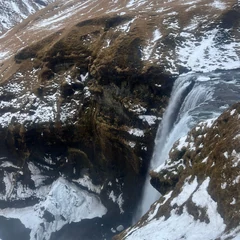
Sólheimajökull Glacier Hike & Ice Climbing Intro
★ 4.8 · 447 reviews · Free cancellation 24 h